静态语义分析(类型检查、作用域分析)与中间代码(TAC、AST/DAG/SSA)生成,包括借助翻译模式实现类型检查、声明/数组/表达式/布尔表达式/控制流的翻译、拉链与代码回填技术。
1 概述
1.1 编译前端到中端
静态语义分析与中间代码生成处于编译流程的 前端尾部 与 中端首段,承接 语法分析/自底向上语法分析 产生的语法树,并通过 符号表 协同完成类型与作用域信息的建立。
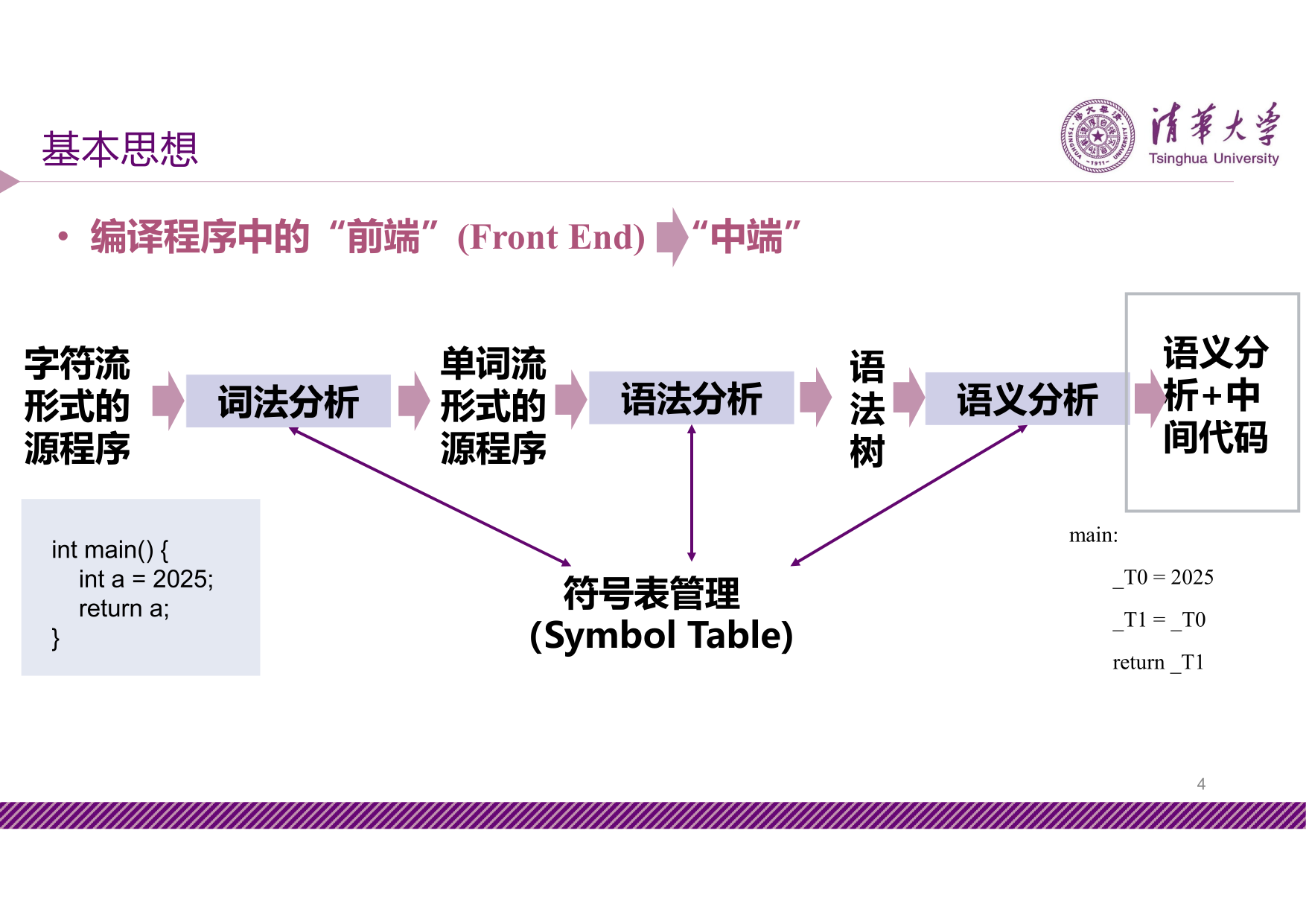
典型编译过程的阶段划分如下:
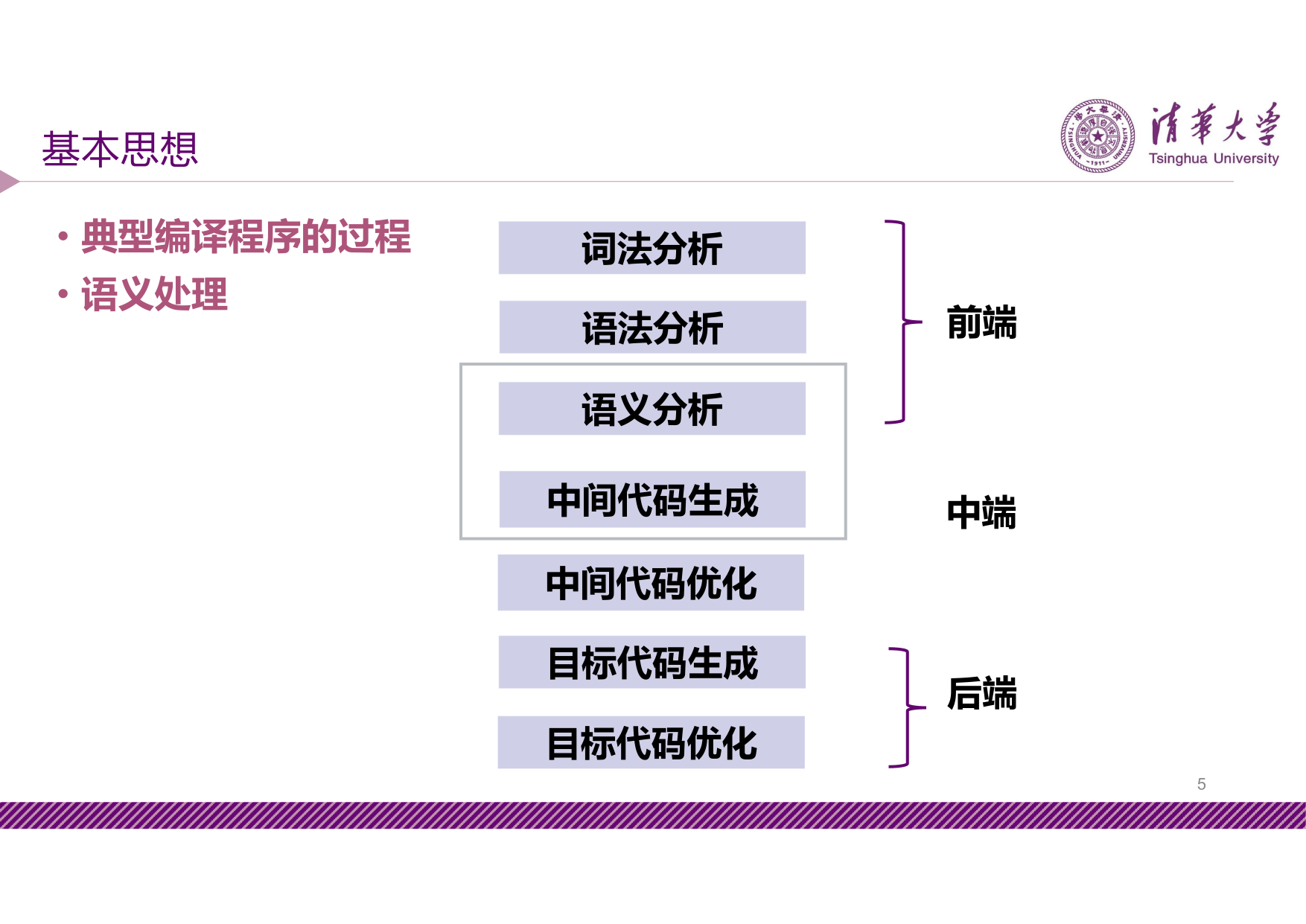
本讲在编译流程中的位置
静态语义分析属于 前端最后一步(语义检查与信息收集),中间代码生成属于 中端起点(生成与目标无关的中间表示),二者通过 翻译模式(translation scheme) 共同实现,可看作 语法制导翻译 的具体应用。
1.2 重要数据结构:符号表
详见 符号表。这里只强调符号表在静态语义分析中的角色:
- 名字信息(种类、类型、偏移地址、占用空间等)由 声明的语义动作 写入
- 引用名字时通过 查表 获取类型,用于类型检查与中间代码生成
- 符号表的组织(栈式 / 嵌套)体现 作用域规则
1.3 范例语言:类 MiniDecaf 抽象语法
后续所有翻译模式均以下面这个简化的小语言为基础:
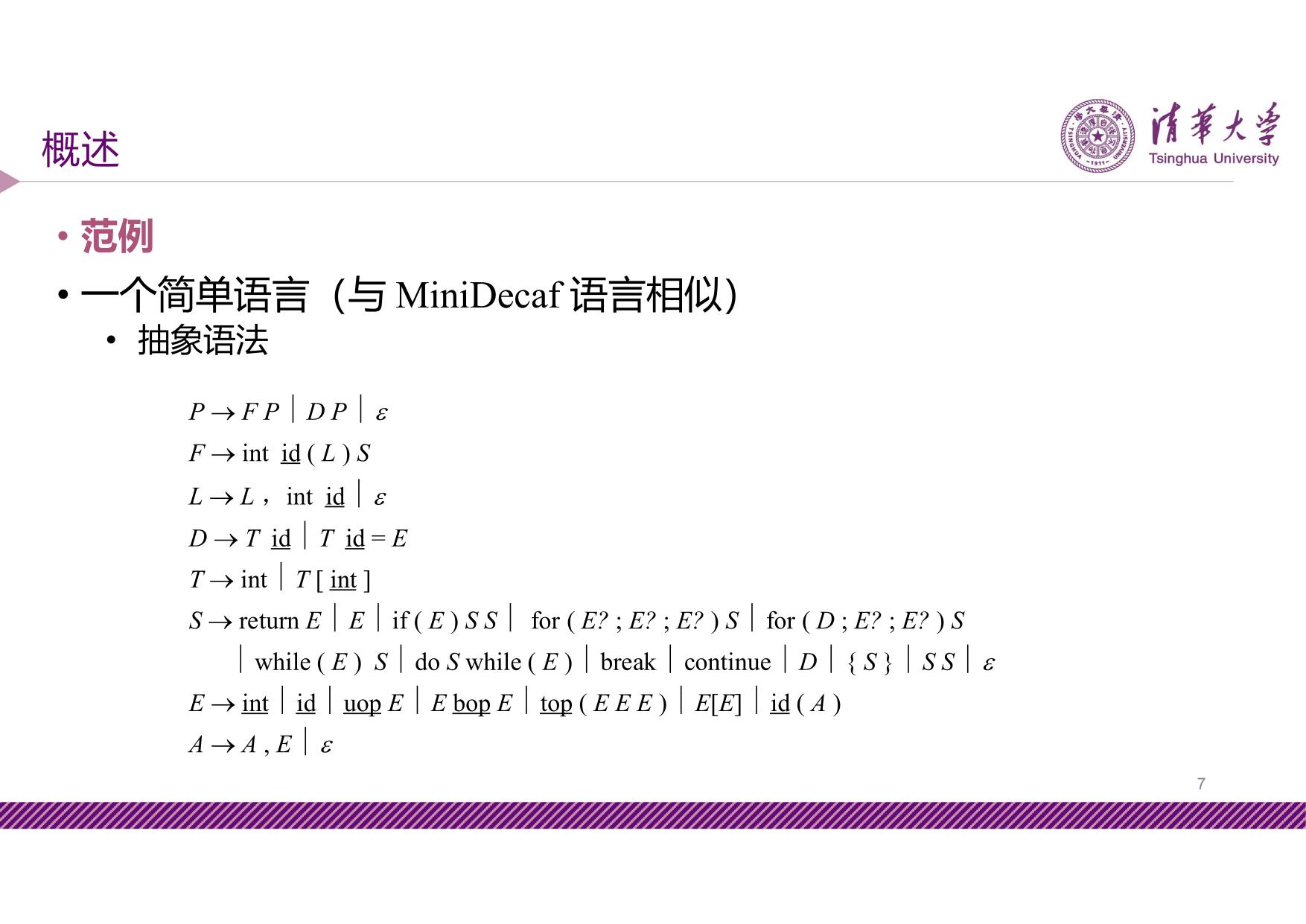
阅读约定
\(D\) 表示声明,\(T\) 表示类型构造,\(F\) 表示函数定义,\(L\) 表示形参列表,\(E\) 表示表达式,\(S\) 表示语句,\(A\) 表示实参列表,\(P\) 表示程序。元变量 \(l \in \{\text{in}, \text{out}\}\) 用来表示当前是否在循环体中(影响 break/continue 的合法性)。
1.4 总体方法:借助翻译模式描述实现算法
静态语义分析与中间代码生成都通过为产生式附加 语义动作 来实现:
这种翻译模式可以 直接对应到递归下降的类型检查器 / 中间代码生成器 的伪代码实现。
2 静态语义分析
2.1 与语义分析相关的工作
定义 2.1(静态/动态语义检查)
编译期间所进行的语义检查为 静态语义检查;所生成代码在运行期间进行的语义检查为 动态语义检查。
静态语义分析的工作主要分两类:
- 静态语义检查(编译期完成)
- 收集语义信息(为代码生成等后续阶段服务)
2.2 静态语义检查的种类
静态语义检查的常见种类
这是程序合法性检查的最后阶段,主要包含:
- 静态类型检查(type checks):每个操作是否遵守类型系统
- 作用域分析(scope):建立名字的定义和使用之间的联系
- 控制流检查(flow-of-control checks):例如 break 必须有合法循环包围
- 唯一性检查(uniqueness checks):例如枚举元素不能重复
- 名字的上下文相关性检查(name-related checks):某些名字的多次出现间应满足上下文相关性
2.3 类型检查与类型系统
定义 2.2(类型检查程序)
类型检查程序(type checker)负责类型检查,主要功能为:
- 验证语言结构是否匹配上下文所期望的类型
- 为相关阶段搜集及建立必要的类型信息
- 实现某个 类型系统(type system)
类型系统由四个范畴构成:
- 语法范畴:定义合法的程序单元
- 语义范畴:定义类型表达式
- 类型环境:定义标识符作用域并维护变量类型
- 类型规则:为程序单元定义类型表达式
2.3.1 类型表达式(面向类 MiniDecaf)
定义 2.3(类型表达式)
类型表达式包括:
- 基本类型表达式:\(int\)
- 数组类型表达式:\(array(\tau)\),其中 \(\tau\) 是基本/数组类型
- 函数类型表达式:\(fun(n)\),\(n \ge 0\) 表示参数个数(在类 MiniDecaf 中参数与返回值都为 \(int\))
- \(type\_error\):专用于有类型错误的程序单元
- \(ok\):专用于无类型错误的程序单元
2.3.2 类型环境
定义 2.4(类型环境)
类型环境是一个从程序部分标识符集到类型表达式集合的函数 \(\Gamma\),用于记录某上下文中标识符被赋予的类型表达式。
记号约定:
- 设类型环境为 \(\Gamma\),\([\underline{id} \mapsto t]\) 表示对类型环境的更新
- \(\Gamma[\underline{id} \mapsto t]\) 表示以 \(\mathrm{dom}(\Gamma) \cup \{\underline{id}\}\) 为定义域的类型环境
- 含义:对任意 \(x \in \mathrm{dom}(\Gamma) \cup \{\underline{id}\}\),若 \(\underline{id} = x\) 则结果为 \(t\),否则为 \(\Gamma(x)\)
Update 函数
定义特殊函数 \(\mathrm{Update}(\Gamma, s)\):返回对 \(\Gamma\) 更新了语句序列 \(s\) 最外层作用域 所有声明后所得的类型环境。即若 \(s\) 最外层声明了类型为 \(t_1\) 的变量 \(\underline{id}_1\)、\(\dots\)、类型为 \(t_n\) 的变量 \(\underline{id}_n\),则
2.3.3 类型规则(断言形式)
引入三种 断言(judgements) 形式:
其中 \(l \in \{\text{in}, \text{out}\}\)。
例 2.1:表达式类型规则
例 2.2:语句类型规则
例 2.3:类型构造与函数定义
2.3.4 类型系统的相关话题
类型系统的延伸话题
仅作了解,本讲不深入展开:
- 类型等价(equivalence):结构等价、名字等价、合一算法
- 类型推导(inference):静态/动态类型推导
- 子类型(subtyping):类型转换、兼容、多态、重载
- 类型合理性/可靠性(Soundness):类型良定(well-typed)的程序是行为安全的
2.4 借助翻译模式实现类型检查
实现策略
将类型表达式作为 属性值 赋给程序的各个部分;通过 设计恰当的翻译模式,即可实现相应语言的类型系统。
2.4.1 处理声明的翻译模式
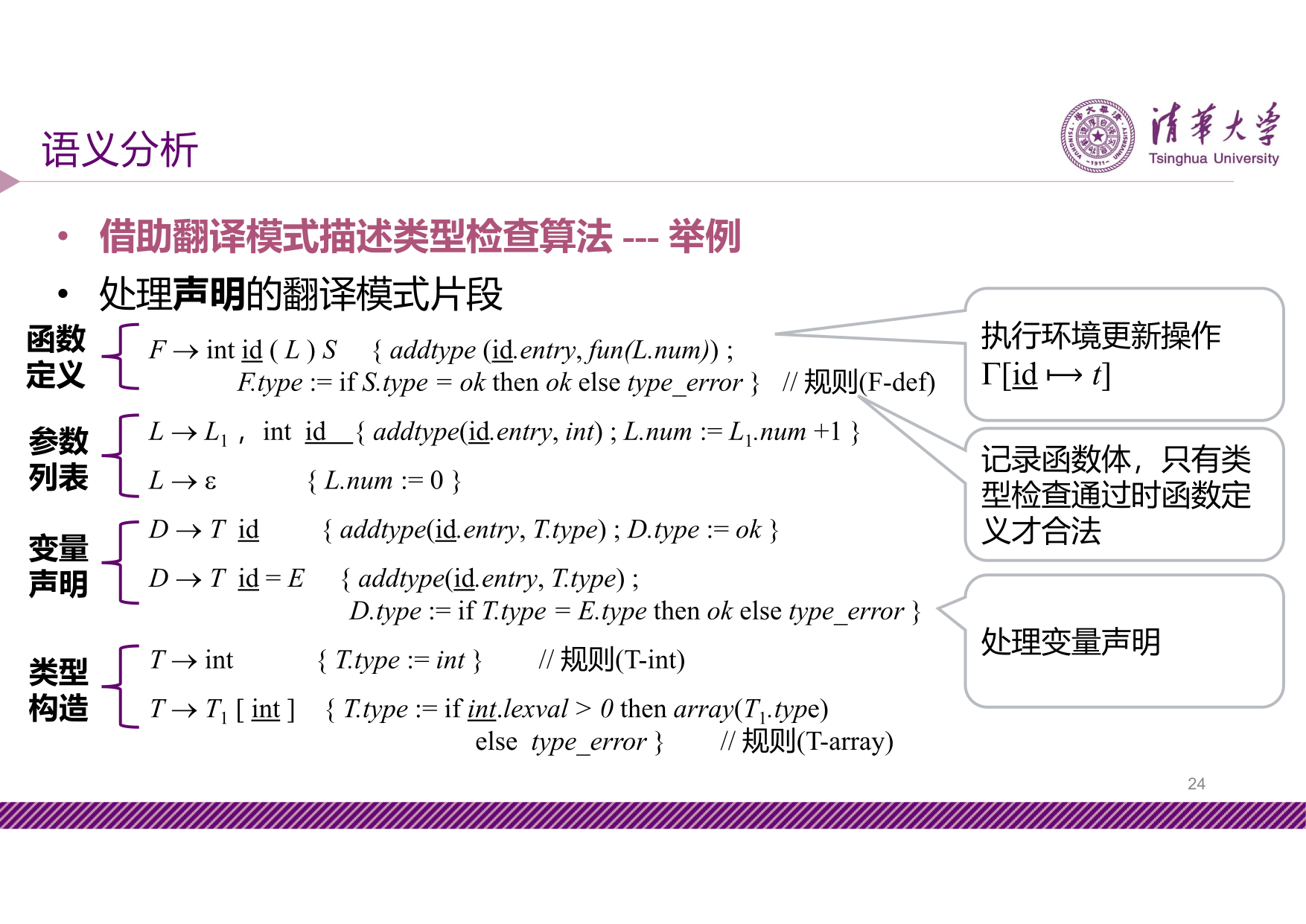
关键动作:
- \(addtype(\underline{id}.entry, \tau)\):在符号表中为 \(\underline{id}\) 登记类型 \(\tau\)(执行环境更新 \(\Gamma[\underline{id} \mapsto t]\))
- \(F\) 的合法性:函数体类型检查通过(\(S.type = ok\))则 \(F.type := ok\),否则 \(type\_error\)
- 数组规则要求 \(\underline{int}.lexval > 0\),否则 \(type\_error\)(对应 E-array 规则)
例 2.4:声明类型错误
代码:
报错:
int y = 1.5;触发 (T-int) 错误(赋值类型不匹配,由规则 \(D \to T\ \underline{id} = E\) 中 \(T.type \ne E.type\) 触发 \(type\_error\))int a[0];触发 (T-array) 错误(数组长度必须 > 0)
例 2.5:函数定义错误
代码:
报错:触发 (F-def) 错误,因为函数体语句序列类型不为 \(ok\)(return 语句要求表达式类型为 \(int\))。
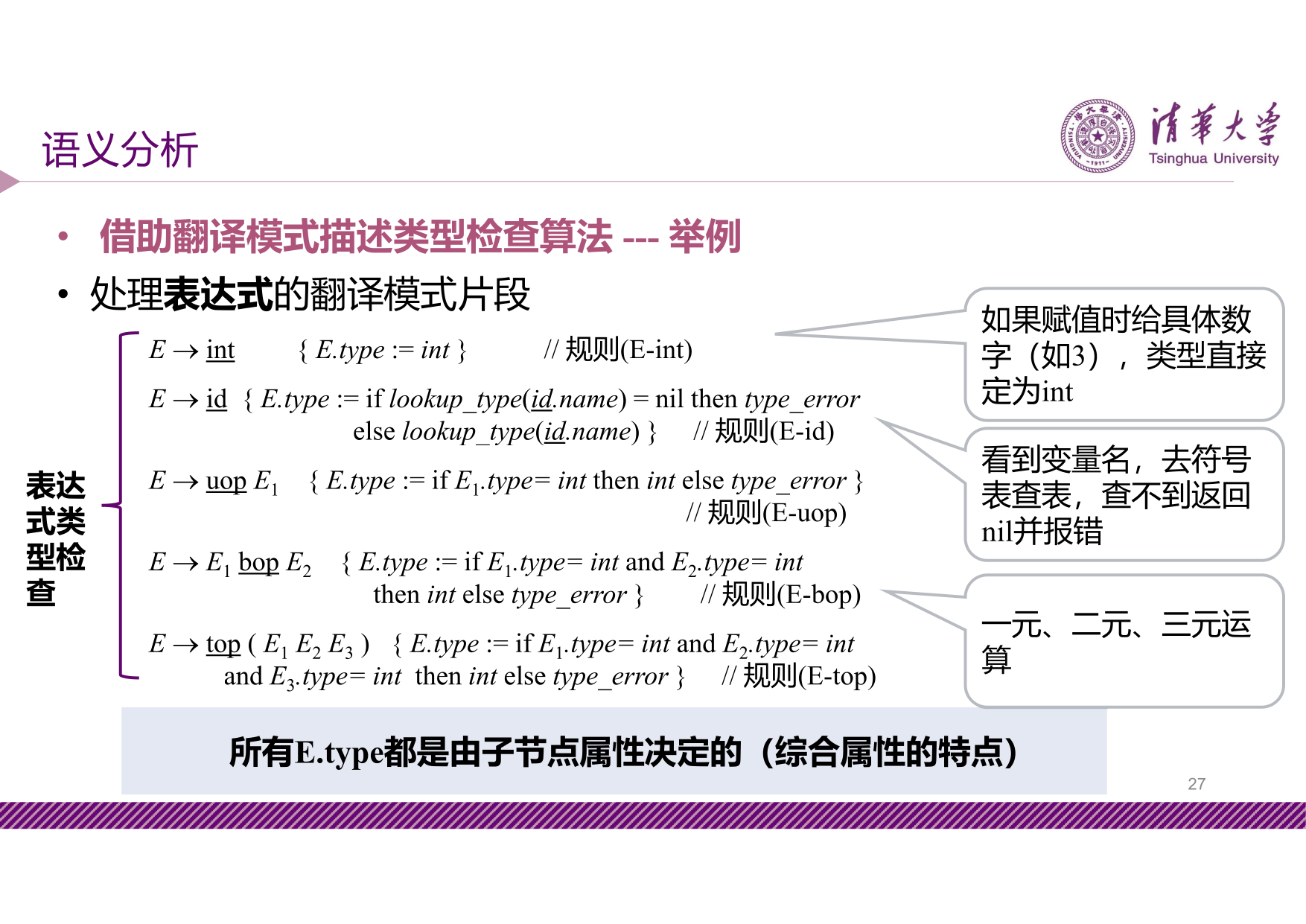
2.4.2 处理表达式的翻译模式
综合属性的特点
所有 \(E.type\) 都是由 子节点属性 决定的——这正是 综合属性(synthesized attribute) 的典型特征,因此可在自底向上分析(如 LR)中自然地完成。
补充规则(数组访问、函数调用、参数列表):
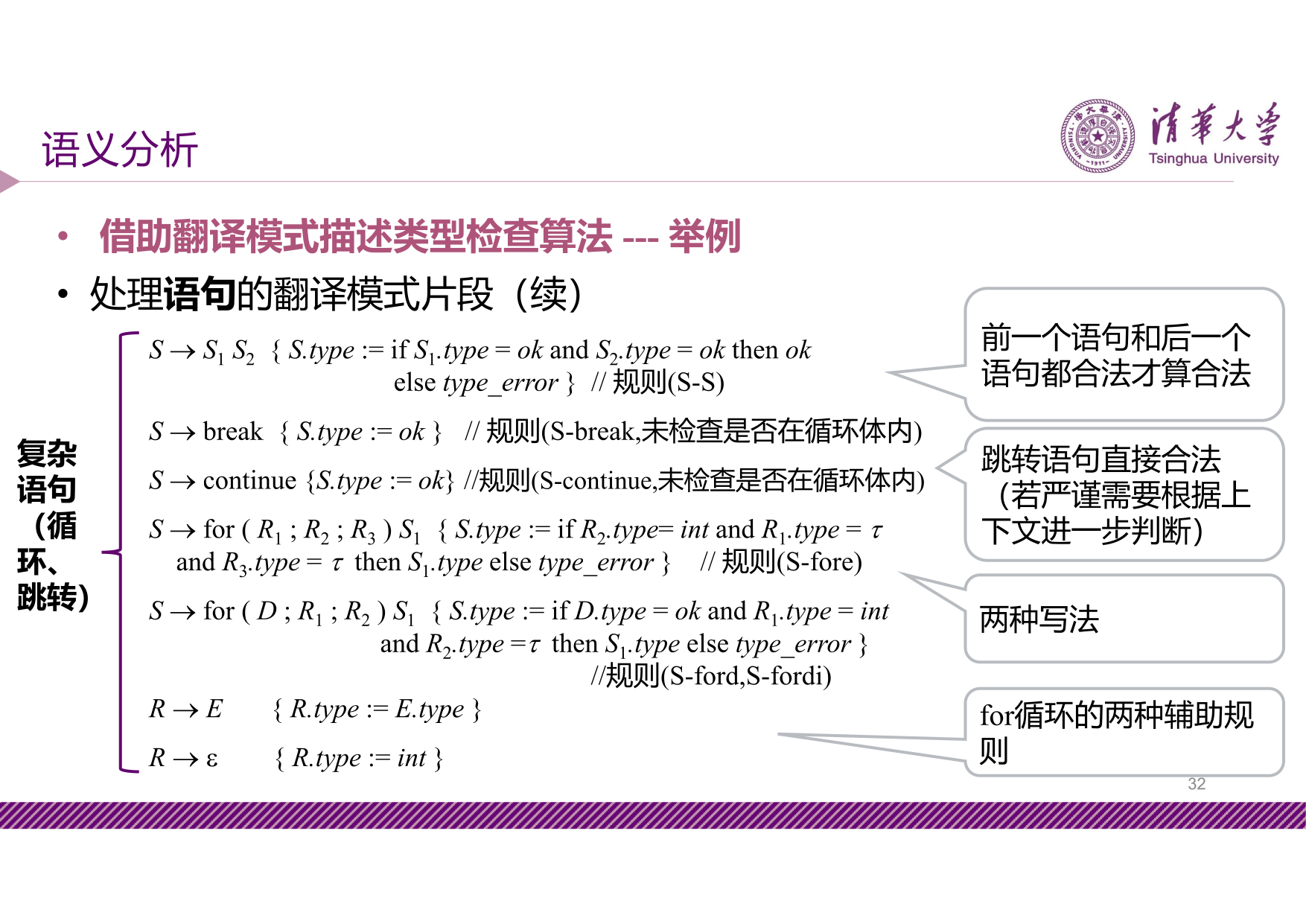
2.4.3 处理语句的翻译模式
break/continue 的检查
上图中的 (S-break)、(S-continue) 直接置为 \(ok\),未检查是否在循环体内。要更严格,需要 继承属性 inloop 来传递上下文信息。
2.4.4 引入 inloop 继承属性
定义 2.5(inloop 继承属性)
增加 inloop 是一个 继承属性:在循环结构中将 inloop 置为 1,沿语法树向下传播;break/continue 检查 inloop = 1 才合法。
修改后的关键产生式:
2.5 作用域分析
3 中间代码生成
3.1 中间代码的作用与形式
定义 3.1(中间代码 Intermediate Code)
源程序的不同表示形式,作为 源语言与目标语言之间的桥梁。
作用:
- 避开源/目标之间较大的语义跨度,使编译程序逻辑结构更简单明确
- 利于编译程序的 重定向(同一前端 + 不同后端)
- 利于进行 与目标机无关的优化
3.1.1 常见中间代码形式
五种常见中间代码
- AST(Abstract Syntax Tree,抽象语法树)
- TAC(Three-Address Code,三地址码 / 四元式)
- P-code(特别用于 Pascal 语言实现)
- Bytecode(Java 编译器的输出,JVM 的输入)
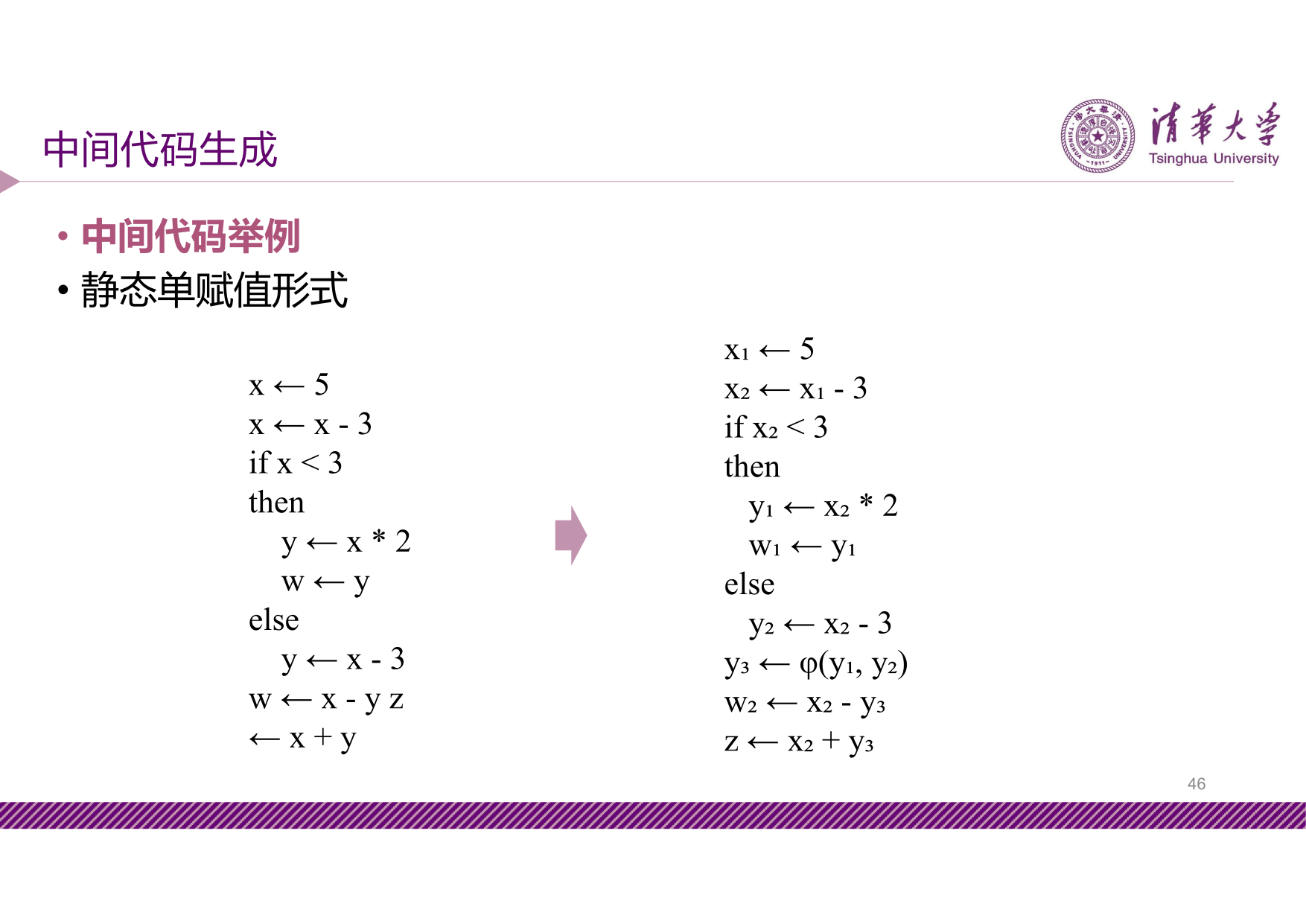
- SSA(Static Single Assignment Form,静态单赋值形式)
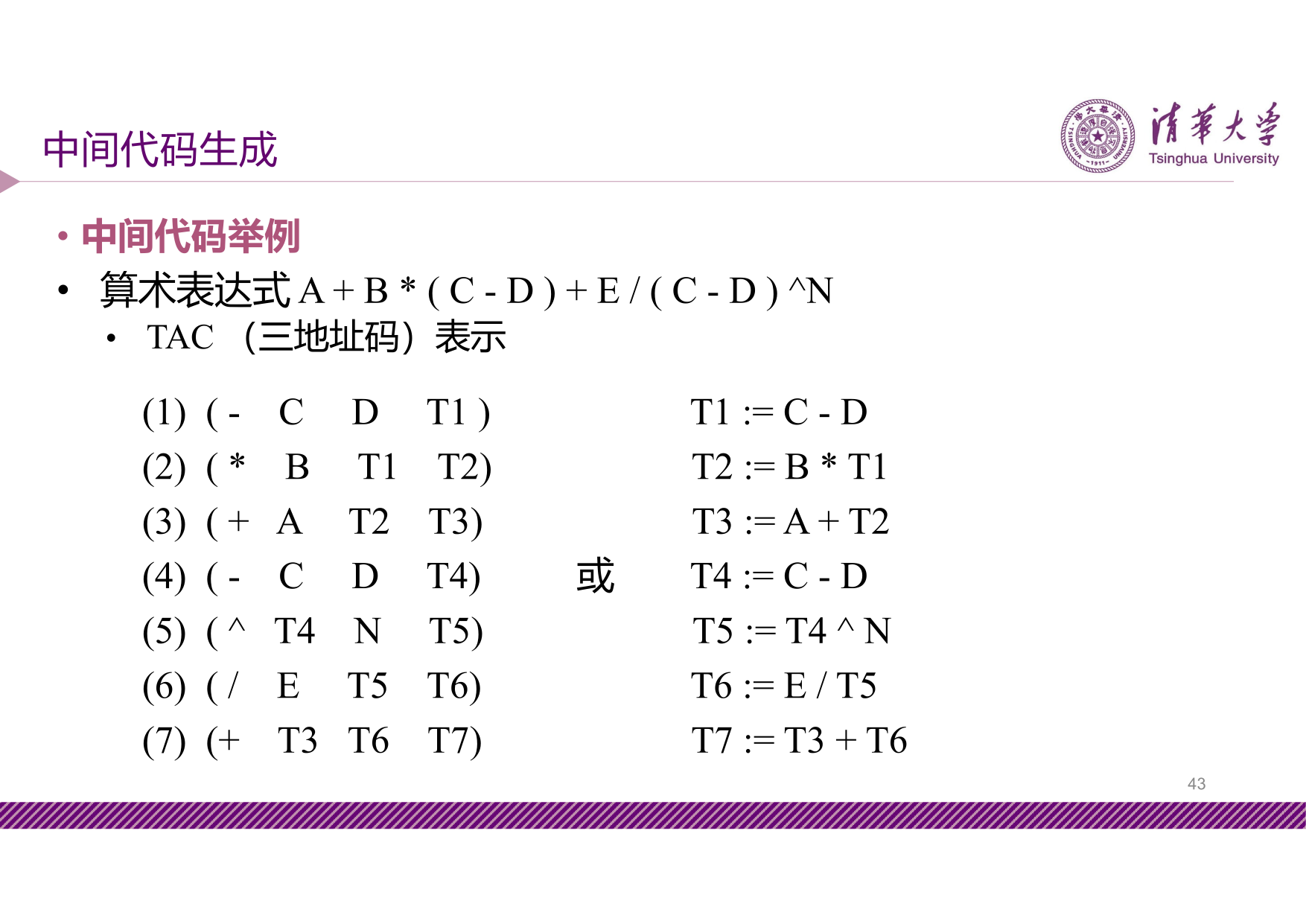
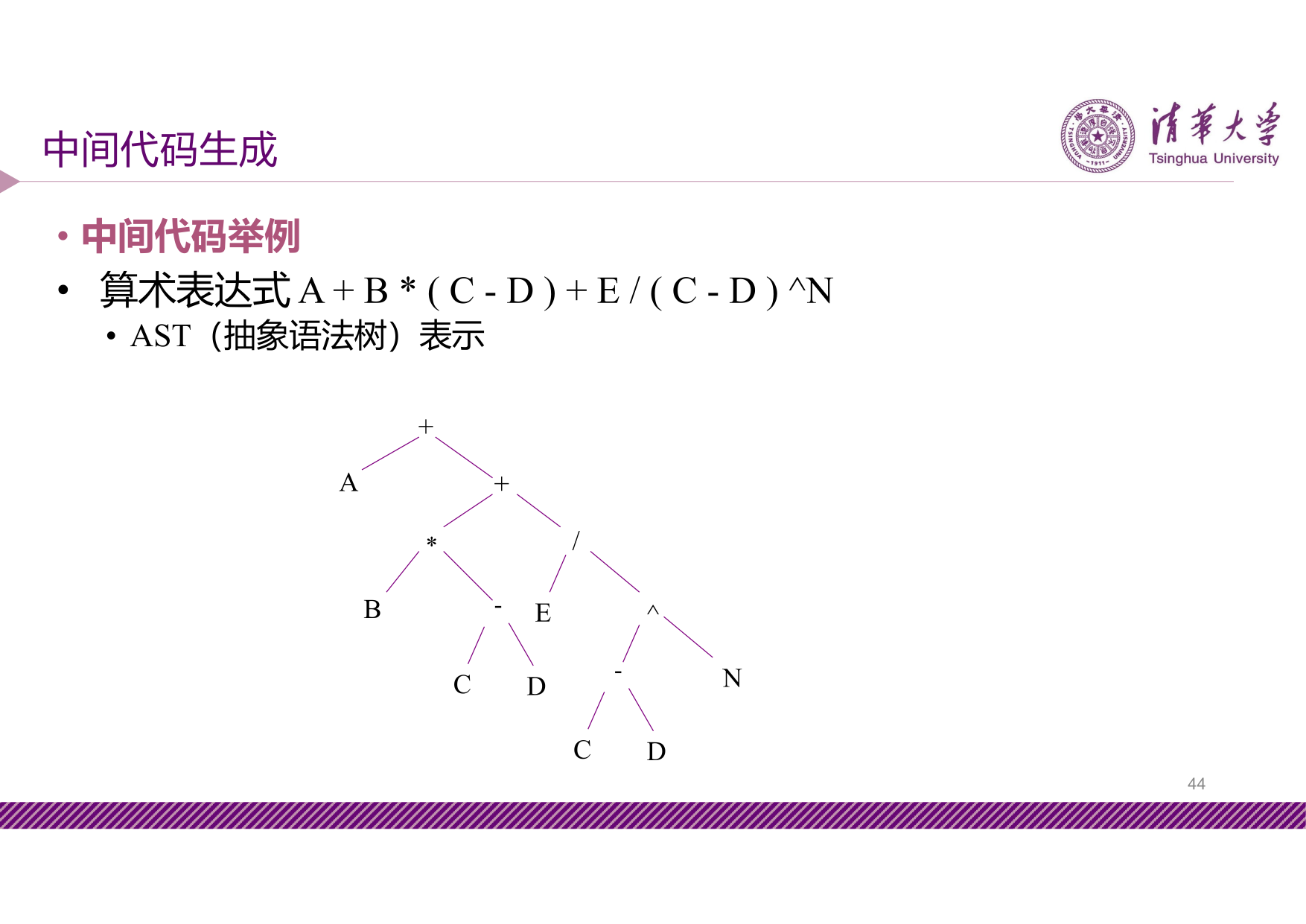
3.1.2 同一表达式的多种表示
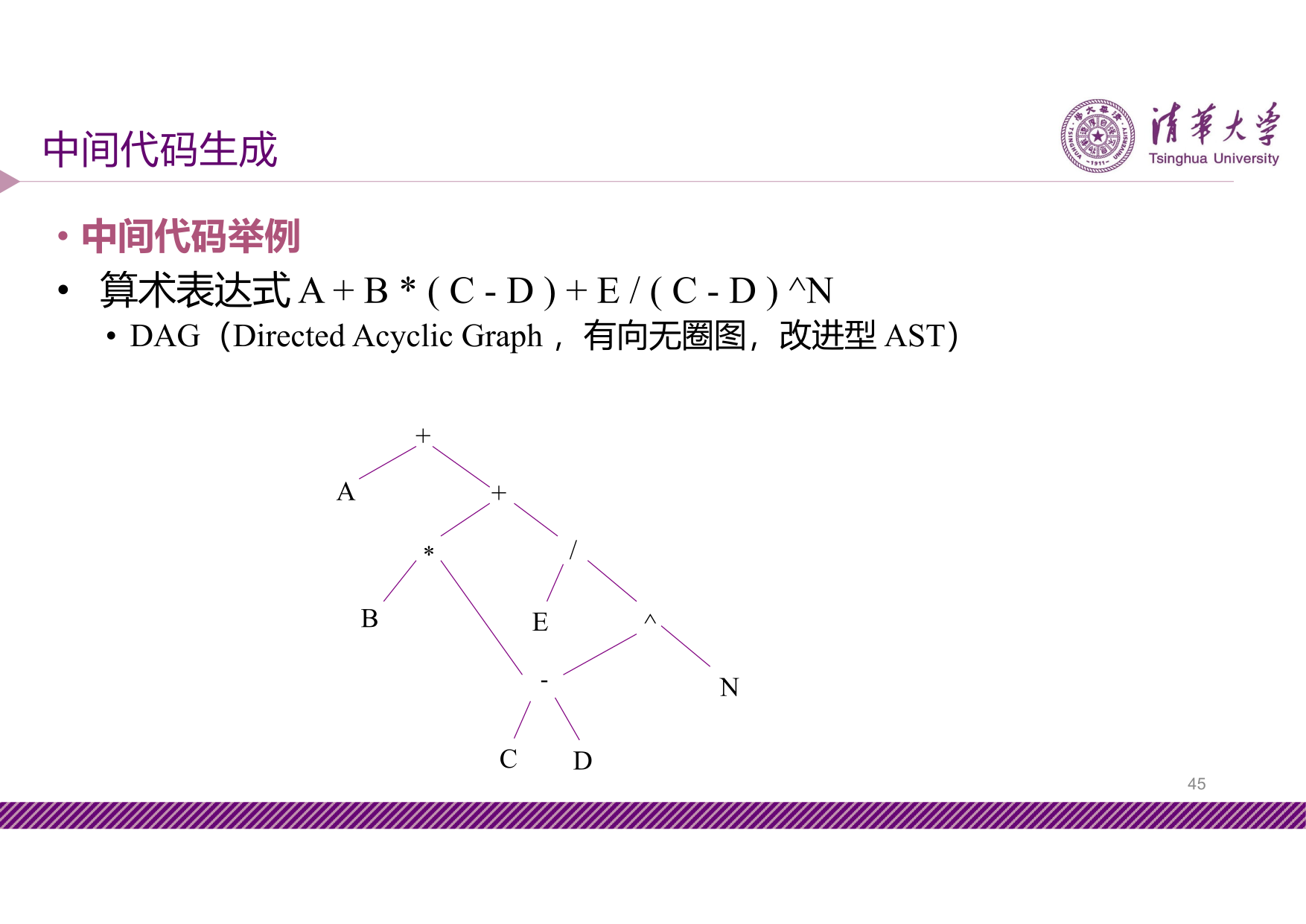
以 \(A + B \times (C - D) + E / (C - D)^N\) 为例。
TAC 表示(三地址码):
AST 表示:
DAG 表示(有向无圈图,改进型 AST,可共享公共子表达式):
SSA 形式(每个变量只赋值一次,控制流汇合处用 \(\varphi\) 函数):
SSA 的关键
SSA 中每个变量在 整个程序中只被赋值一次,控制流合并处用 \(\varphi(y_1, y_2)\) 表示「若来自 then 分支取 \(y_1\),否则取 \(y_2\)」。这极大方便了后续的数据流分析与优化。
3.2 语法制导生成 AST
中间代码生成可借助 语法制导 方法(如 yacc)。AST 构造的核心动作是 \(mknode\)(构造内部结点)和 \(mkleaf\)(构造叶结点):
3.3 三地址码 TAC
定义 3.2(三地址码 TAC)
TAC 是顺序的语句序列,每条语句一般具有形式 \(x := y\ op\ z\),其中 \(op\) 为操作符,\(y\)、\(z\) 为操作数,\(x\) 为结果。
3.3.1 课程后续用到的 TAC 语句类型
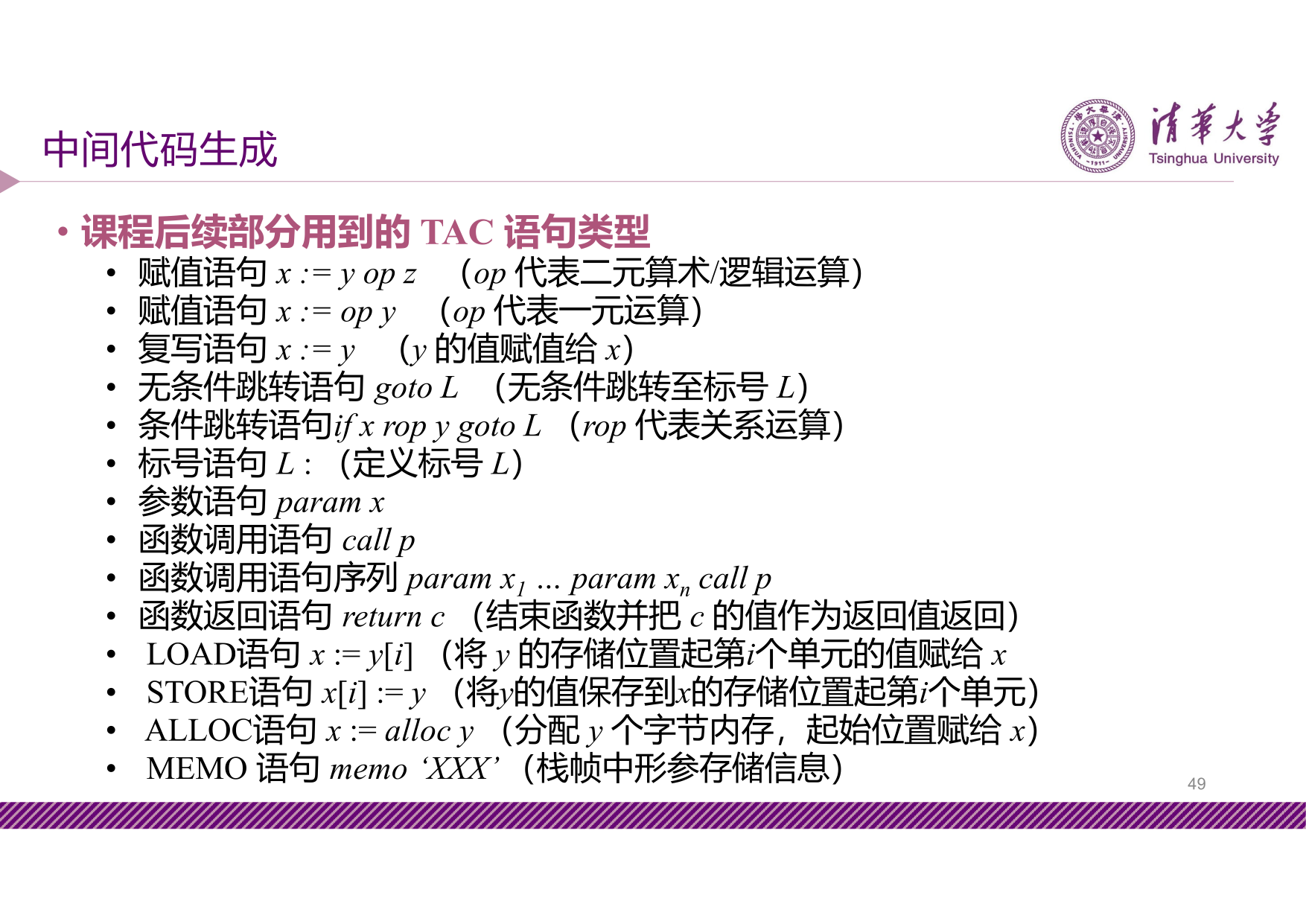
完整列表:
- 赋值语句:\(x := y\ op\ z\)(二元)、\(x := op\ y\)(一元)
- 复写语句:\(x := y\)
- 无条件跳转:\(\text{goto}\ L\)
- 条件跳转:\(\text{if}\ x\ \text{rop}\ y\ \text{goto}\ L\)
- 标号语句:\(L:\)
- 参数语句:\(\text{param}\ x\);函数调用:\(\text{call}\ p\)
- 函数返回:\(\text{return}\ c\)
- LOAD:\(x := y[i]\);STORE:\(x[i] := y\)
- ALLOC:\(x := alloc\ y\);MEMO:\(\text{memo}\ \text{`XXX'}\)(栈帧形参存储信息)
3.4 声明语句的翻译
3.4.1 全局声明:offset 与 width
Prog → { P.offset := 0 } P
P → { F.offset := 0 } F { P_1.offset := P.offset } P_1 { P.width := P_1.width }
P → { D.offset := P.offset } D { P_1.offset := P.offset + D.width } P_1
    { P.width := D.width + P_1.width }
P → ε  { P.width := 0 }
D → T id   { enter(id.name, D.offset); D.width := T.width }
D → T id = E { enter(id.name, D.offset); D.width := T.width }
T → int    { T.width := 4 }
T → T_1 [int]  { T.width := int.lexval × T_1.width }
offset 与 width 的属性类型
- offset:继承属性,表示在内存中的起始地址偏移
- width:综合属性,表示占用内存字节数
基础整数类型占 4 字节;数组总宽度 = 元素个数 (\(\underline{int}.lexval\)) × 单个元素宽度 (\(T_1.width\))。
3.4.2 局部声明:每函数独立计算偏移
每个函数独立计算局部偏移,\(enter\) 表示在 局部符号表 中登记相应的偏移信息:
F → int id ( { L.offset := F.offset } L ) { S.offset := F.offset + L.width } S
L → { L_1.offset := L.offset } L_1 , int id
    { enter(id.name, L.offset + L_1.width); L.width := L_1.width + 4 }
L → ε  { L.width := 0 }
S → if (E) { S_1.offset := S.offset } S_1
    { S_2.offset := S.offset } S_2 { S.width := 0 }
S → while (E) { S_1.offset := S.offset } S_1 { S.width := 0 }
S → for (D; R_1; R_2) { S_1.offset := S.offset + D.width } S_1 { S.width := 0 }
S → '{' { S_1.offset := S.offset } S_1 '}' { S.width := 0 }
注意 \(S.width\) 通常置 0(控制流语句本身不占新空间),仅 \(S \to D\) 沿用 \(D.width\)。
3.5 数组的翻译
3.5.1 数组的内情向量(dove vector)
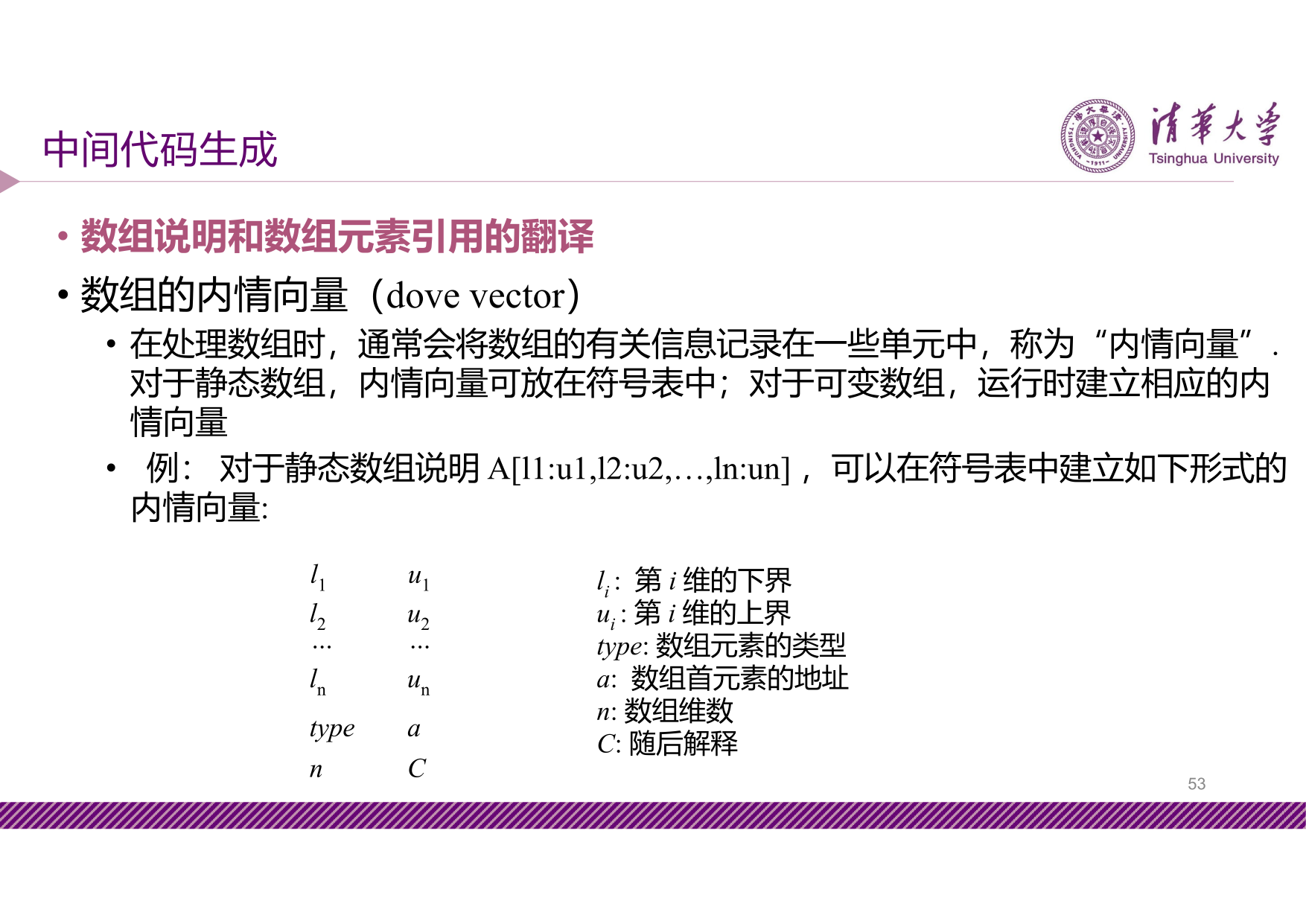
定义 3.3(内情向量 dove vector)
处理数组时将数组的相关信息记录在一些单元中,称为 内情向量。
- 静态数组:内情向量放在符号表中
- 可变数组:运行时建立内情向量
内情向量字段:\(l_i, u_i\)(第 \(i\) 维下/上界)、\(type\)(元素类型)、\(a\)(首元素地址)、\(n\)(数组维数)、\(C\)(地址计算辅助常量)。
3.5.2 数组元素的地址计算
对静态数组 \(A[l_1:u_1, l_2:u_2, \dots, l_n:u_n]\),行优先连续布局,元素 \(A[i_1, i_2, \dots, i_n]\) 的地址:
整理得 \(D = a - C + V\),其中:
拆分思路
\(C\) 仅依赖 下界 \(l_i\) 与维大小,编译期可算,存入内情向量;\(V\) 依赖 运行时下标 \(i_j\),运行时计算。
3.5.3 数组声明与元素引用的 TAC 生成
D → T id  { x := newtemp; y := newtemp;
            if T.type = int then D.code := ε
            else D.code := gen(y ':=' D.offset) ||
                           gen(x ':=' 'alloc' T.width) ||
                           gen(y'[' '0' ']' ':=' x) ||
                           gen(y'[' '1' ']' ':=' T.width) }

D → T id = E  { x := newtemp; y := newtemp;
                if T.type = int then D.code := E.code || gen(id.place ':=' E.place)
                else D.code := E.code || gen(y ':=' D.offset) ||
                               gen(y'[' '0' ']' ':=' E.place) ||
                               gen(y'[' '1' ']' ':=' T.width) }

E → E_1[E_2]  { E.place := newtemp;
                E.code := E_1.code || E_2.code ||
                          gen(E.place ':=' E_1.place '[' E_2.place ']') }
3.6 表达式的翻译
3.6.1 语义属性与函数
表达式翻译用到的属性与函数
语义属性:
- \(\underline{id}.place\):\(\underline{id}\) 对应的存储位置
- \(E.place\):用来存放 \(E\) 的值的存储位置
- \(E.code\)、\(A.code\):相应的 TAC 语句序列
语义函数/过程:
- \(gen\):生成一条 TAC 语句
- \(newtemp\):新建未用过的名字,返回存储位置
- \(newlabel\):返回一个新的语句标号
- \(\|\):TAC 语句序列之间的链接运算
- \(A.arglist\):实参地址列表;\(makelist\)、\(append\) 用于维护列表
3.6.2 翻译模式
三元运算(如条件运算 \(E_1 ? E_2 : E_3\)):
3.6.3 函数调用
例 3.1:函数调用 a = foo(x, y)
处理完参数生成的代码:
处理完赋值语句:a := t1(\(t_1\) 是临时变量,存放调用结果)。
3.7 布尔表达式的翻译
3.7.1 两种翻译策略
布尔表达式的两条路线
- 直接对布尔表达式求值:用 1 表示 true、0 表示 false,类似算术表达式那样求值
- 通过控制流体现布尔表达式语义:通过转移到程序中的某个位置来表示求值结果。优点:方便实现控制流语句中布尔表达式翻译;常可以得到 短路代码(short-circuit),避免不必要求值
3.7.2 直接求值方式
nextstat
\(nextstat\) 返回输出代码序列中下一条 TAC 语句的下标。
例 3.2:a = x < y 的直接求值
源代码 int x = 0; int y = 1; a = x < y;,按 \(E \to \underline{id}_1\ \underline{rop}\ \underline{id}_2\) 规则翻译:
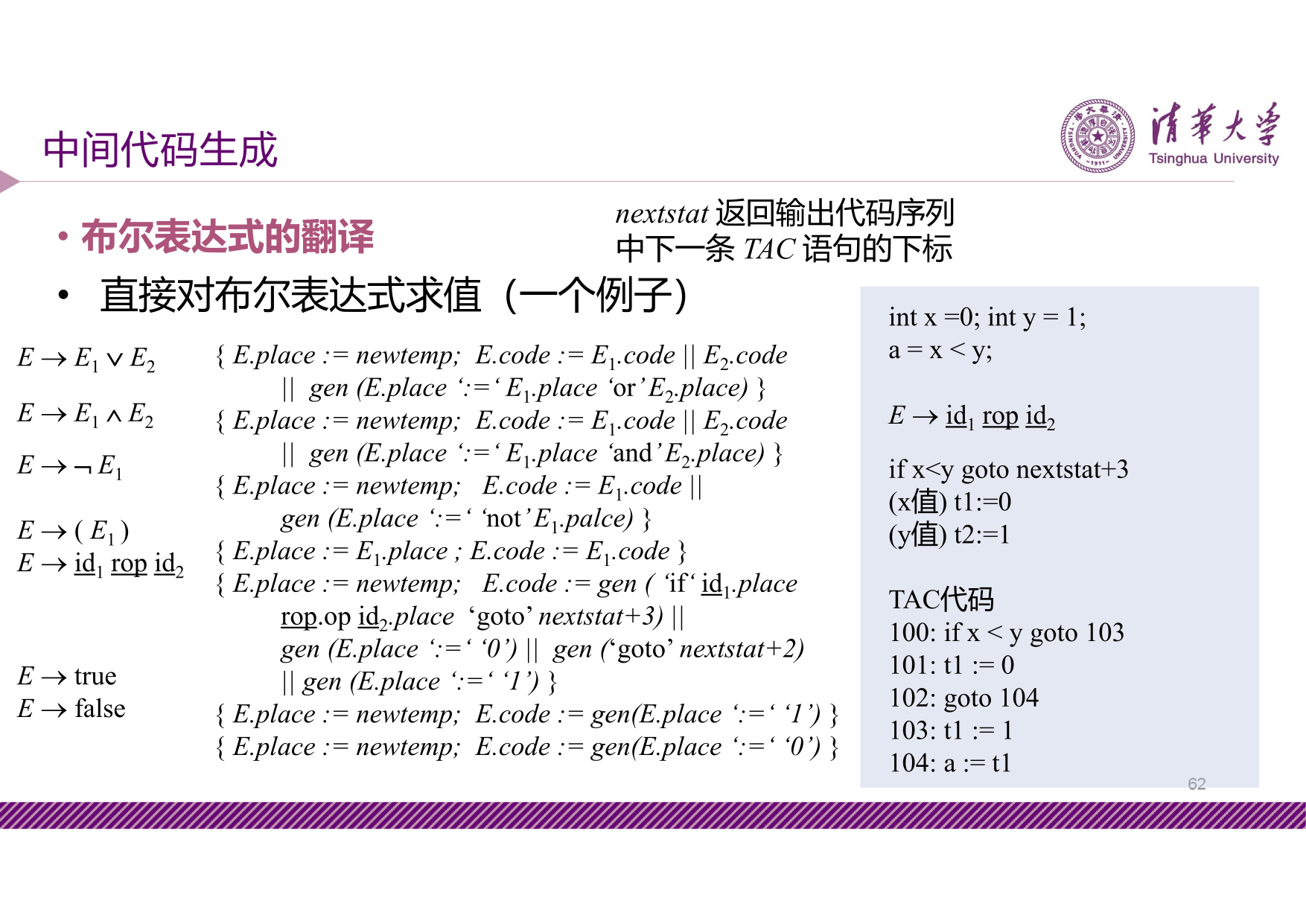
生成的 TAC:
3.7.3 短路代码(控制流方式)
布尔表达式 \(E = a < b\ \text{or}\ c < d\ \text{and}\ e < f\) 的短路翻译:
if a < b goto E.true
   goto label1
label1:
   if c < d goto label2
   goto E.false
label2:
   if e < f goto E.true
   goto E.false
短路求值
已知 \(E_1\) 为真时,不必再对 \(E_1 \vee E_2\) 中的 \(E_2\) 求值;已知 \(E_1\) 为假时,不必再对 \(E_1 \wedge E_2\) 中的 \(E_2\) 求值。
3.7.4 短路代码翻译模式(L-翻译模式)
L-翻译模式利用 继承属性 \(E.true\)、\(E.false\) 表示 \(E\) 为真/假时跳转的目标标号:
3.8 控制流语句的翻译(L-翻译模式)
继承属性 \(S.next\) 表示 \(S\) 之后要执行的首条 TAC 语句的标号。
3.8.1 if-then 与 if-then-else
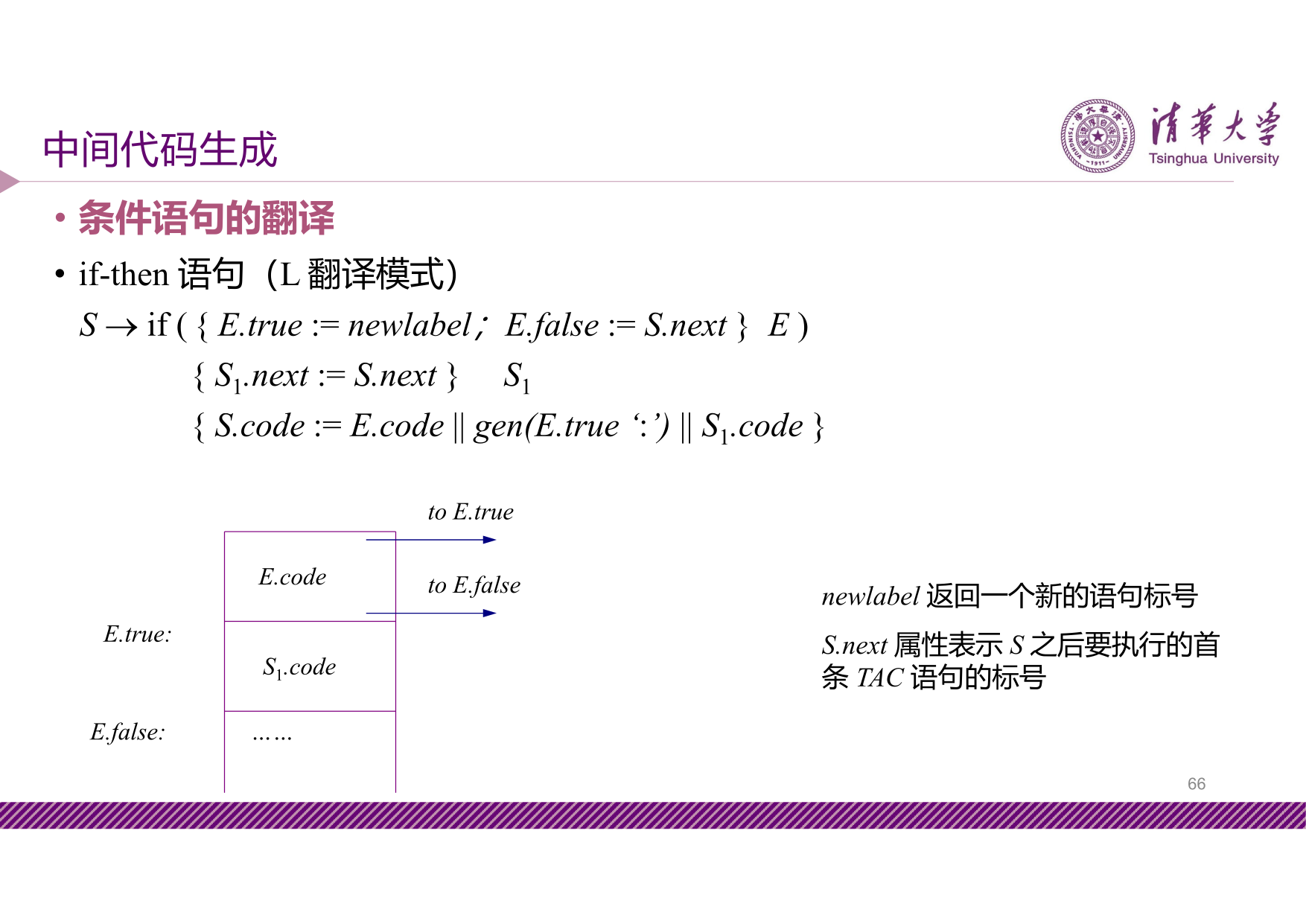
S → if (
    { E.true := newlabel; E.false := S.next } E )
    { S_1.next := S.next } S_1
    { S.code := E.code || gen(E.true ':') || S_1.code }
if-then-else 控制流:
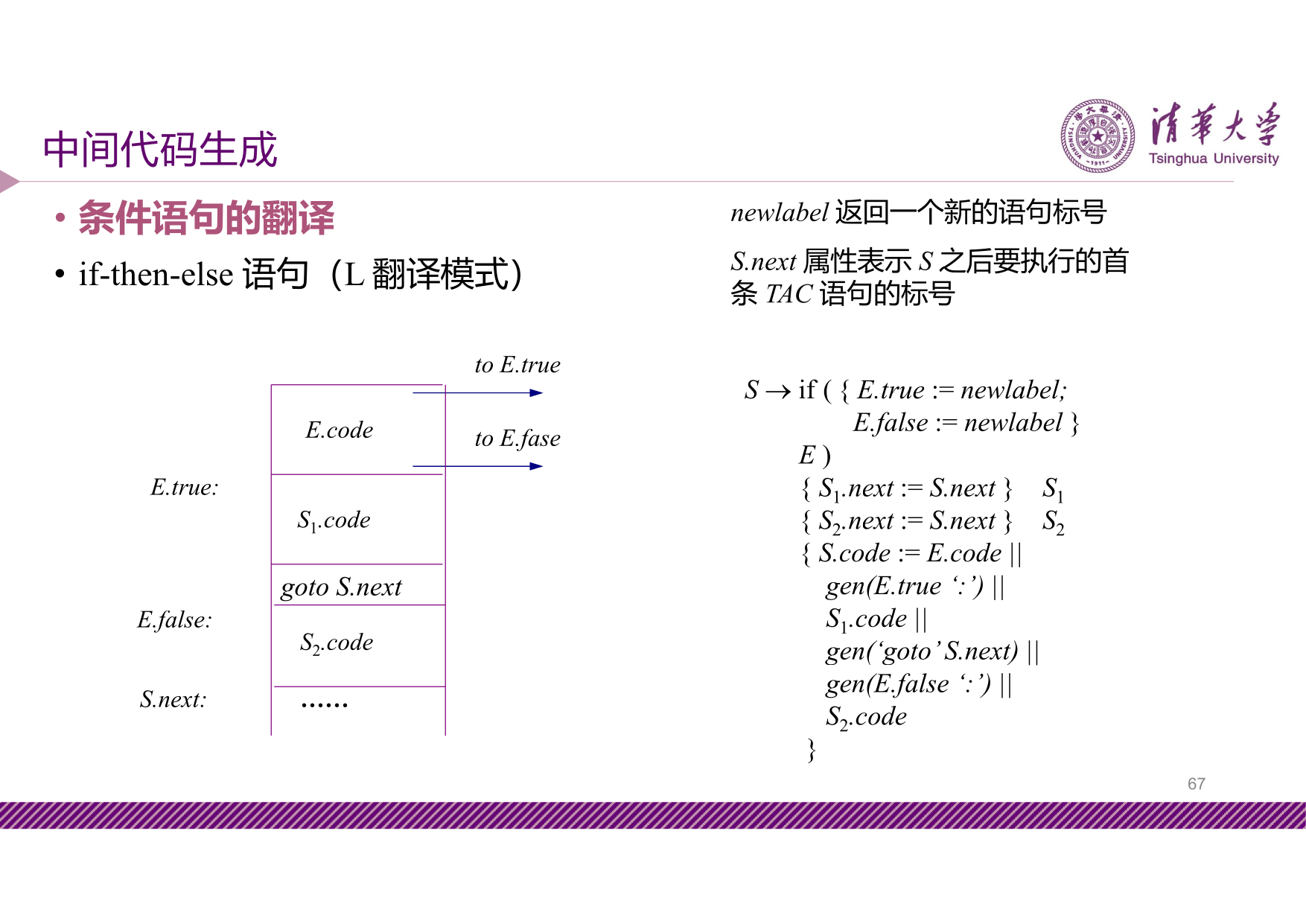
S → if (
    { E.true := newlabel; E.false := newlabel } E )
    { S_1.next := S.next } S_1
    { S_2.next := S.next } S_2
    { S.code := E.code ||
                gen(E.true ':') || S_1.code ||
                gen('goto' S.next) ||
                gen(E.false ':') || S_2.code }
3.8.2 while 语句
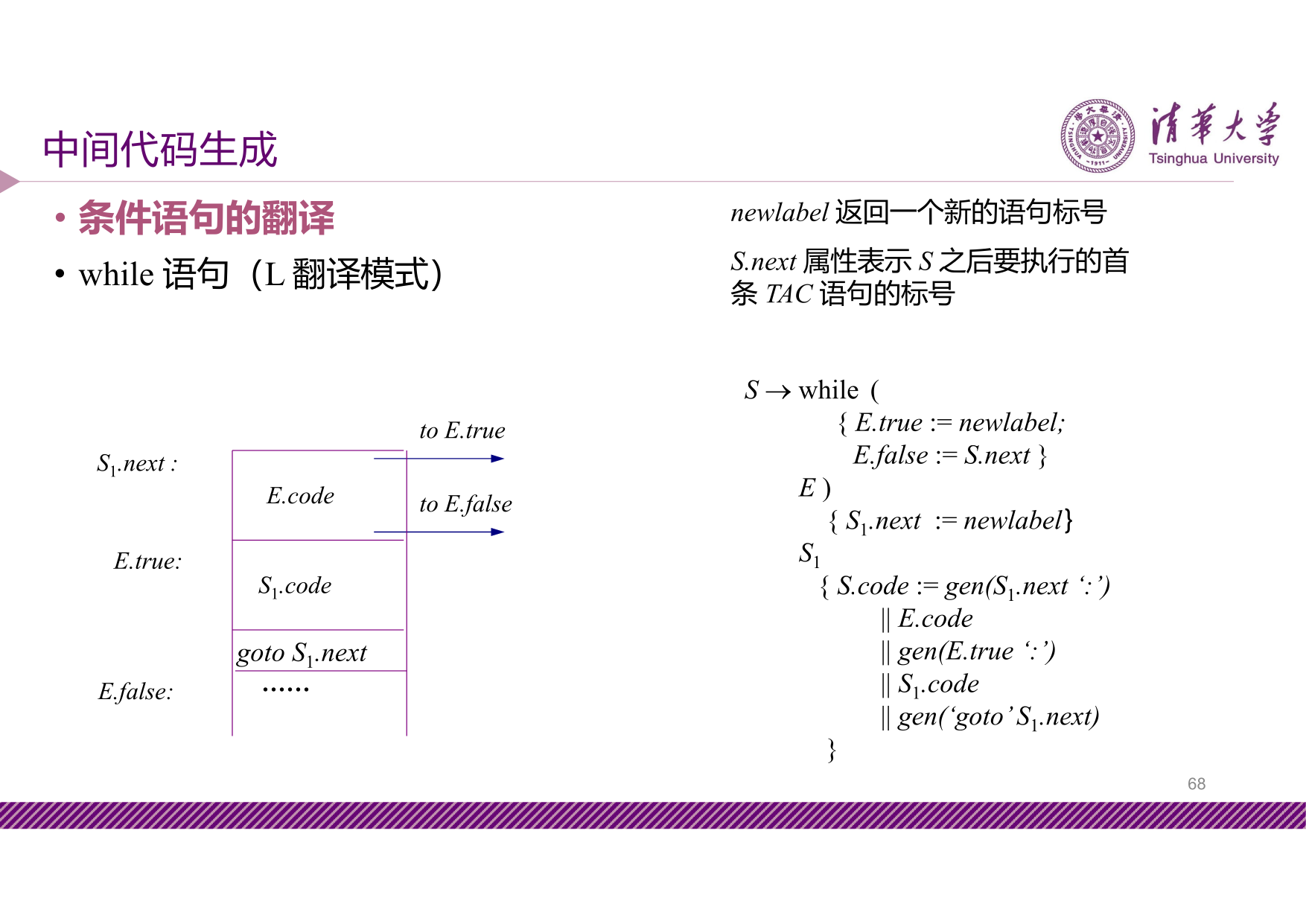
S → while (
    { E.true := newlabel; E.false := S.next } E )
    { S_1.next := newlabel }
    S_1
    { S.code := gen(S_1.next ':') || E.code || gen(E.true ':') ||
                S_1.code || gen('goto' S_1.next) }
3.8.3 顺序复合语句
S → { S_1.next := newlabel } S_1
    { S_2.next := S.next } S_2
    { S.code := S_1.code || gen(S_1.next ':') || S_2.code }
3.8.4 完整程序的 TAC 序列
Prog → P  { output(P.code) }
P → { F.begin := newlabel } F P_1
    { P.code := gen(F.begin ':') || F.code || P_1.code }
P → D P_1  { P.code := D.code || P_1.code }
P → ε  { P.code := ε }
F → int id ( L ) S  { addplace(id.entry, F.begin);
                     S.code := gen('memo' '''' L.code '''') || S.code }
L → L_1, int id  { L.width := L_1.width + 4;
                   L.code := L_1.code || gen(id.name ':' L_1.width + 4) }
L → ε  { L.width := 0; L.code := ε }
addplace
将函数名与对应的代码起始标号关联,方便后续函数调用跳转。
3.8.5 含 break 语句的翻译
引入继承属性 \(S.break\) 表示 break 应跳到的标号(最外层 while 的结束位置):
F → int id ( L )  { S.next := newlabel; S.break := newlabel } S
    { S.code := gen('memo' '''' L.code '''') || S.code || gen(S.next ':') }

S → if ( { E.true := newlabel; E.false := S.next } E )
    { S_1.next := S.next; S_1.break := S.break } S_1
    { S.code := E.code || gen(E.true ':') || S_1.code }

S → while ( { E.true := newlabel; E.false := S.next } E )
    { S_1.next := newlabel; S_1.break := S.next } S_1
    { S.code := gen(S_1.next ':') ||
                E.code || gen(E.true ':') || S_1.code ||
                gen('goto' S_1.next) }

S → break  { S.code := gen('goto' S.break) }
break 标号传递
\(S.break\) 沿语法树向下传递,确保任何嵌套位置的 break 都能找到最外层 while 的「大出口」。
3.9 拉链与代码回填(backpatching)
又一种控制流中间代码生成技术
- 前面的 L-翻译模式:使用 L-属性文法/翻译模式(含继承属性)
- 拉链回填:使用 S-属性文法/翻译模式(仅综合属性,可一遍 LR)
3.9.1 语义属性
定义 3.4(真链、假链、next 链)
- \(E.truelist\):「真链」,链表中元素表示一系列跳转语句的地址,这些跳转目标是「\(E\) 为真」的标号
- \(E.falselist\):「假链」,目标是「\(E\) 为假」的标号
- \(S.nextlist\):「next 链」,目标是紧跟 \(S\) 之后的下条 TAC 语句的标号
3.9.2 语义函数
拉链回填的辅助函数
- \(makelist(i)\):创建只有结点 \(i\) 的表,对应存放目标 TAC 语句数组的下标
- \(merge(p_1, p_2)\):连接两个链表 \(p_1\) 和 \(p_2\)
- \(backpatch(p, i)\):将链表 \(p\) 中每个元素所指向的跳转语句的标号置为 \(i\)
- \(nextstm\):下一条 TAC 语句的地址
- \(emit(\dots)\):输出一条 TAC 语句,并使 \(nextstm\) 加 1
- \(M \to \varepsilon\):通过非终结符 \(M\) 的 \(M.gotostm := nextstm\) 来 抓取当前位置
3.9.3 处理布尔表达式的翻译模式
E → E_1 ∨ M E_2  { backpatch(E_1.falselist, M.gotostm);
                   E.truelist := merge(E_1.truelist, E_2.truelist);
                   E.falselist := E_2.falselist }

E → E_1 ∧ M E_2  { backpatch(E_1.truelist, M.gotostm);
                   E.falselist := merge(E_1.falselist, E_2.falselist);
                   E.truelist := E_2.truelist }

E → ¬ E_1  { E.truelist := E_1.falselist; E.falselist := E_1.truelist }

E → ( E_1 )  { E.truelist := E_1.truelist; E.falselist := E_1.falselist }

E → id_1 rop id_2  { E.truelist := makelist(nextstm);
                     E.falselist := makelist(nextstm + 1);
                     emit('if' id_1.place rop.op id_2.place 'goto _');
                     emit('goto _') }

E → true  { E.truelist := makelist(nextstm); emit('goto _') }
E → false  { E.falselist := makelist(nextstm); emit('goto _') }

M → ε  { M.gotostm := nextstm }
backpatch 的核心思想
关系比较 emit 的两条 goto 暂时填 _(空目标)。当上层规约时,已知跳转目标,再用 \(backpatch\) 把同一条链上所有空目标 统一回填。
3.9.4 翻译示例:\(E = a < b\ \vee\ c < d\ \wedge\ e < f\)
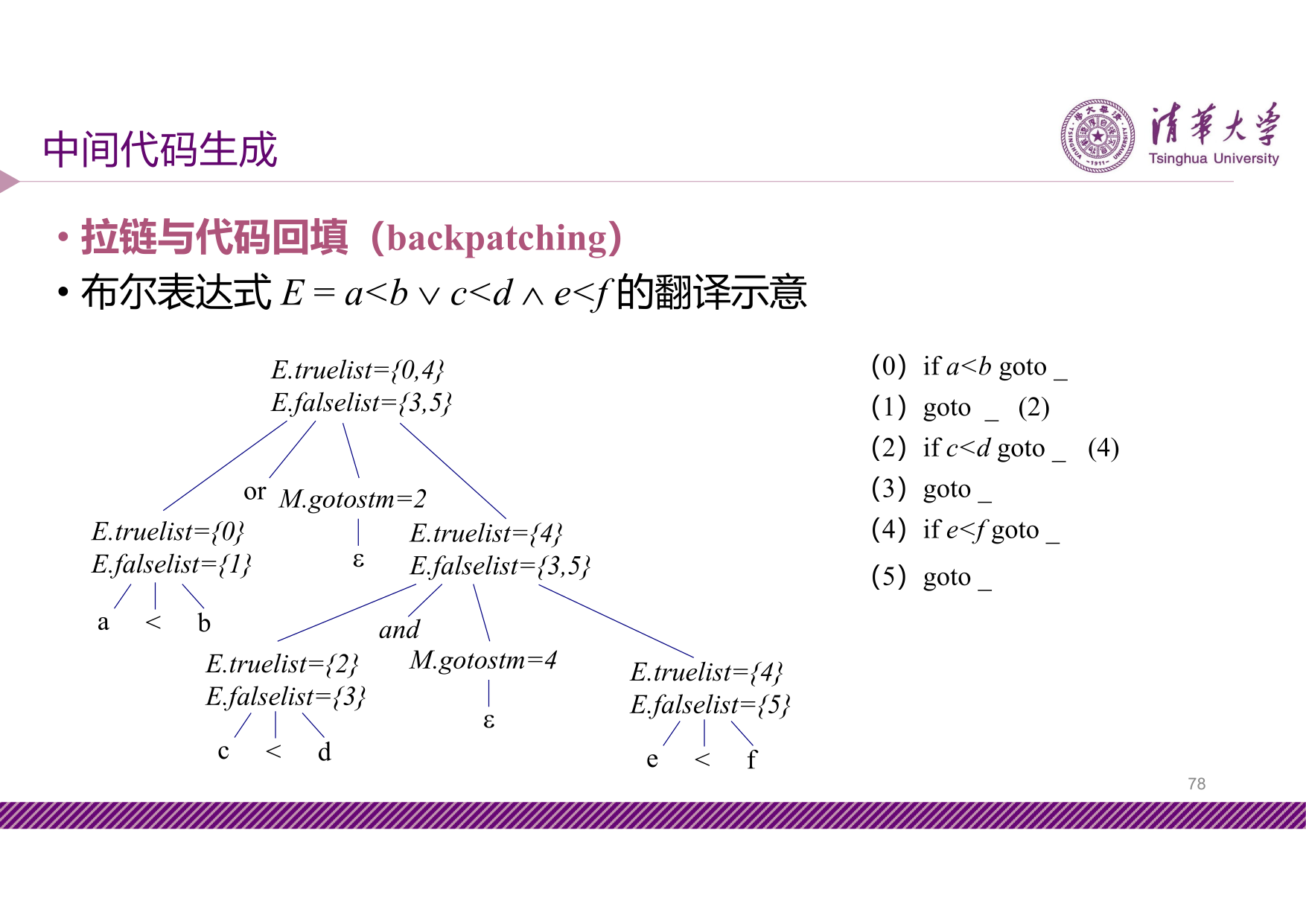
emit 出的 TAC:
(0) if a < b goto _
(1) goto _   (2)
(2) if c < d goto _   (4)
(3) goto _
(4) if e < f goto _
(5) goto _
每个内部节点合并子节点的真/假链,最终 \(E.truelist = \{0, 4\}\)、\(E.falselist = \{3, 5\}\),由上层(如 if 的 then/else 标号)回填。
3.9.5 处理条件语句
S → if ( E ) M S_1
    { backpatch(E.truelist, M.gotostm);
      S.nextlist := merge(E.falselist, S_1.nextlist) }

S → if ( E ) M_1 S_1 N else M_2 S_2
    { backpatch(E.truelist, M_1.gotostm);
      backpatch(E.falselist, M_2.gotostm);
      S.nextlist := merge(S_1.nextlist, merge(N.nextlist, S_2.nextlist)) }

N → ε  { N.nextlist := makelist(nextstm); emit('goto _') }
3.9.6 处理循环、复合、块、表达式语句
S → while ( M_1 E ) M_2 S_1
    { backpatch(S_1.nextlist, M_1.gotostm);
      backpatch(E.truelist, M_2.gotostm);
      S.nextlist := E.falselist;
      emit('goto', M_1.gotostm) }

S → S_1 M S_2  { backpatch(S_1.nextlist, M.gotostm);
                 S.nextlist := S_2.nextlist }

S → { S_1 }  { S.nextlist := S_1.nextlist }
S → B  { S.nextlist := B.nextlist }
M → ε  { M.gotostm := nextstm }
while 的核心逻辑
若 \(E\) 为假,跳到 while 之外(\(S.nextlist := E.falselist\));若 \(S_1\) 执行完,跳回循环条件起始位置 \(M_1\)。
3.9.7 含 break 的拉链回填
引入 \(S.breaklist\),链表元素是跳转地址,目标是直接所属 while 的结束位置:
F → int id ( L ) S M  { backpatch(S.nextlist, M.gotostm);
                        backpatch(S.breaklist, M.gotostm) }

S → if ( E ) M S_1  { backpatch(E.truelist, M.gotostm);
                      S.nextlist := merge(E.falselist, S_1.nextlist);
                      S.breaklist := S_1.breaklist }

S → while ( M_1 E ) M_2 S_1
    { backpatch(S_1.nextlist, M_1.gotostm);
      backpatch(E.truelist, M_2.gotostm);
      S.nextlist := merge(E.falselist, S_1.breaklist);
      S.breaklist := ε;
      emit('goto', M_1.gotostm) }

S → break  { S.breaklist := makelist(nextstm); S.nextlist := ε;
             emit('goto _') }
break 的「大出口」
while 在闭合处接收来自子节点的 \(breaklist\) 与 \(E.falselist\) 一起回填到 while 之外的位置(整个循环的「大出口」)。break 自己不写 nextlist,因为它根本不会落到下一条语句。
3.10 GOTO 语句的语法制导翻译
3.10.1 拉链回填技术示例
源中间代码(标号 \(L\) 在 (40) 处定义):
第一次扫描时,\(L\) 还没看到,前向 goto 被 拉成一条链:(100) goto 0、(200) goto 100、(300) goto 200。等扫到 \(L:\)(标号 (400))时,沿链反向 回填 为 400:
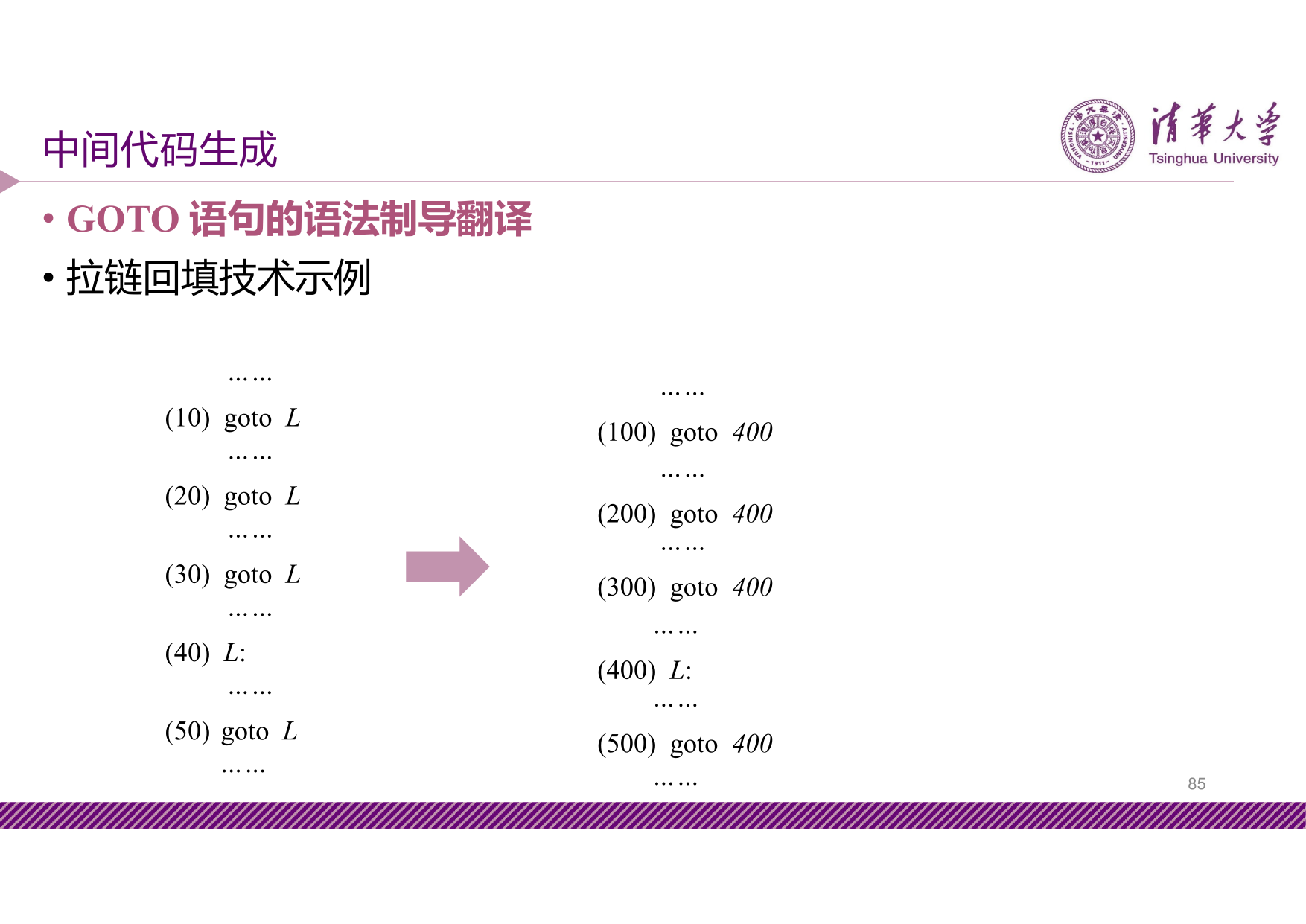
链表用 goto 自身的目标字段串起
巧妙之处:在尚未确定目标时,新 goto 的「目标字段」直接指向 上一条同标号未回填 goto 的下标,从而把整条链表存在 emit 出来的指令里,无需额外数据结构。
3.10.2 利用标号符号表项维护拉链
标号符号表项的字段
- \(name\)、\(kind\)、\(level\) 等(与其他符号一样)
- \(defined\):表示该标号的说明是否已处理过
- \(add\):处理之前用于拉链;处理之后表示翻译后所指向的 TAC 语句位置
辅助过程:
- \(setlbdefined(\underline{id}.name, x)\)、\(getlbdefined(\underline{id}.name)\):设置/获取 \(defined\)
- \(setlbadd(\underline{id}.name, x)\)、\(getlbadd(\underline{id}.name)\):设置/获取 \(add\)
- \(backpatch(nextstm)\):沿拉链反向将所有 goto 的目标回填为 \(nextstm\)
3.10.3 标号说明与 GOTO 语句的翻译模式
S → id : S
    { p := lookup(id.name);
      if (p = nil) then enter(id.name);
      setlbdefined(id.name, 1);
      backpatch(nextstm);
      setlbadd(id.name, nextstm) }

S → goto id
    { p := lookup(id.name);
      if (p = nil) then {
          enter(id.name);
          setlbdefined(id.name, 0);
          setlbadd(id.name, 0);
          emit('goto', 0);
      }
      else emit('goto', getlbadd(id.name));
      if (getlbdefined(id.name) = 0) then setlbadd(id.name, nextstm - 1) }
前向引用与后向引用
- 前向引用(goto 在标号定义之前):\(defined = 0\),emit 的 goto 目标暂填 0,把 \(add\) 更新为这条 goto 的位置——形成拉链
- 后向引用(goto 在标号定义之后):\(defined = 1\),直接 emit 已知的目标地址 \(getlbadd\),不入链
- 标号 \(id:\) 处理时,调用 \(backpatch\) 沿拉链回填整条链上的所有 goto
4 总结
4.1 静态语义分析全景
| 任务 | 实现方式 | 关键属性/函数 |
|---|---|---|
| 静态类型检查 | 翻译模式 + 类型规则 | \(E.type\)、\(lookup\_type\)、\(addtype\) |
| 作用域分析 | 符号表(栈式 / 嵌套) | 见 符号表 |
| 控制流检查 | 继承属性 inloop | \(S.inloop \in \{0, 1\}\) |
| 收集语义信息 | 同时为代码生成准备 | \(T.width\)、\(D.offset\) |
4.2 中间代码生成翻译模式两条路线
| 维度 | L-翻译模式 | S-翻译模式(拉链回填) |
|---|---|---|
| 属性类型 | 继承 + 综合 | 仅综合 |
| 实现配合 | 递归下降 | LR 一遍扫描 |
| 关键属性 | \(E.true\)、\(E.false\)、\(S.next\) | \(E.truelist\)、\(E.falselist\)、\(S.nextlist\) |
| 跳转目标处理 | 自顶向下传递目标 | 暂留空,事后 \(backpatch\) |
| 适用代表语句 | if/while/sequence | 同左 + GOTO 前向引用 |
4.3 核心思想
一句话总结
- 静态语义分析:把 类型规则 与 作用域规则 编码为翻译模式上的语义动作;通过综合/继承属性把 判断结果(\(ok\)、\(type\_error\))沿语法树传播
- 中间代码生成:把 运算/控制流 编码为翻译模式上的语义动作;输出标准的 TAC,短路代码 与 回填技术 是处理控制流跳转的两个关键工具
4.4 与其他章节的联系
- 类型规则与翻译模式的形式化基础:语法制导的语义计算基础
- 名字定义/查询、作用域实现:符号表
- 输入语法树来源:自顶向下语法分析、自底向上语法分析
- 三种分析在编译流程的位置:三种分析的简明理解